
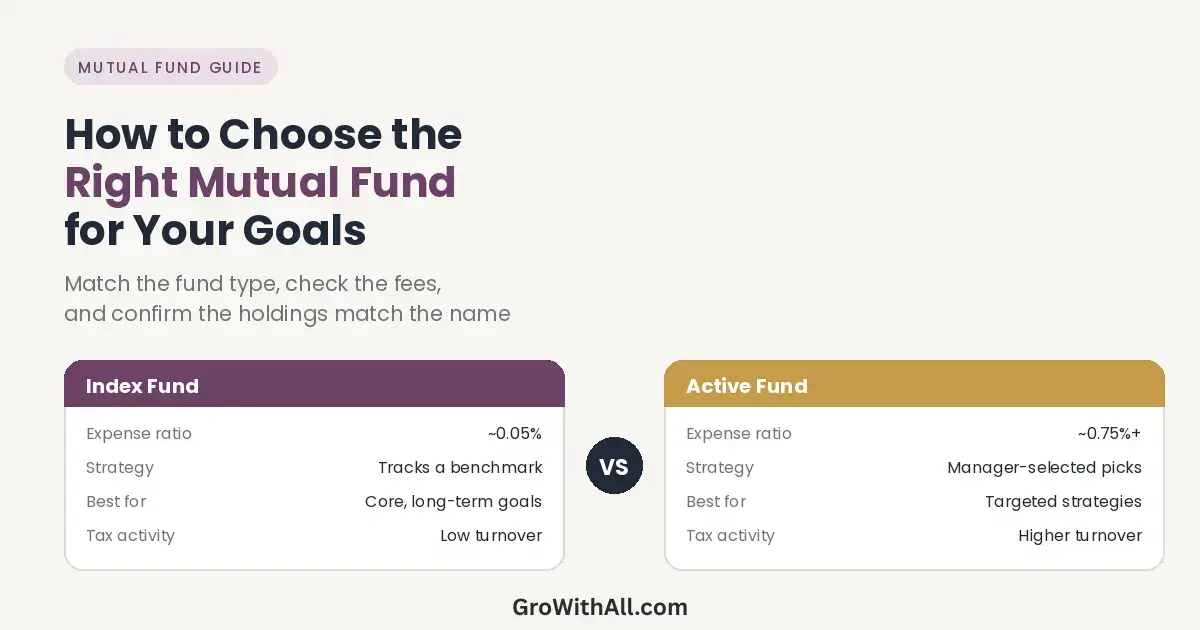
Choosing the right mutual fund starts with your goal, your timeline, and your comfort with risk, not with chasing last year’s top performer. Match the fund type to the job it needs to do, check the fees, and confirm the fund’s holdings actually match what the name suggests.
This guide walks through every factor that matters, in the order most investors should weigh them.
Start With Your Goal, Not the Fund
A mutual fund is a tool, and different tools suit different jobs. Before comparing any specific fund, write down what the money is for and when you will need it.
Retirement savings decades away can handle a fund with higher short-term swings, since time smooths out the ups and downs. A house down payment needed in two years needs a fund built for stability, not growth, since a market drop right before you need the cash could force you to sell at a loss.
A clear goal and timeline point you toward a fund category before you look at a single ticker symbol.
Match the Fund Type to Your Timeline
- Money needed within 1 to 3 years belongs in stable, low-risk options: money market funds, short-term bond funds, or high-yield savings accounts outside the fund world entirely. Stock funds carry too much short-term risk for money you need soon.
- Money needed in 3 to 10 years can handle a balanced fund, holding a mix of stocks and bonds, or a conservative allocation fund. This timeline allows some recovery time from a downturn and limits the full swings of an all-stock fund.
- Money needed in 10 or more years, like early retirement savings, can handle a growth-focused stock fund. A long runway gives the fund time to recover from downturns and capture long-term stock market growth.
Understand the Major Mutual Fund Categories
- Stock funds invest in company shares and aim for long-term growth, with the most short-term price movement of the major categories. These funds range from broad market index funds to funds focused on a single sector or region.
- Bond funds invest in government or corporate debt and aim for steady income with lower volatility than stock funds. Bond fund risk varies by the credit quality and maturity length of the bonds held.
- Balanced or allocation funds hold a fixed or adjustable mix of stocks and bonds in one fund, offering built-in diversification across asset types without needing to manage multiple funds yourself.
- Target-date funds automatically shift from an aggressive, stock-heavy mix toward a more conservative, bond-heavy mix as a target year, usually a retirement year, approaches. These work well for investors who want a single fund that adjusts on its own over time.
- Money market funds hold short-term, high-quality debt instruments and aim to preserve your principal, with minimal growth potential. These suit cash you plan to spend soon.
Index Funds vs Actively Managed Funds
An index fund tracks a specific market benchmark, like the S&P 500, buying and holding the same companies in the same proportion as the index. An actively managed fund employs a manager or team who picks investments they believe will outperform the market.
Index funds typically charge lower fees, since they need no research team picking individual investments. Actively managed funds charge higher fees to cover that research and management effort.
Historical data compiled by firms like S&P Dow Jones Indices consistently shows that most actively managed stock funds fail to beat their benchmark index over long periods, once fees are factored in. This does not mean every actively managed fund underperforms, but it does mean a low-cost index fund is a strong default choice for most goals, particularly for core, long-term holdings.
Check the Expense Ratio First
The expense ratio, the annual fee charged as a percentage of your investment, ranks among the most important numbers to check before buying any fund. This fee comes out of the fund’s returns automatically, whether the fund gains or loses value that year.
A broad index fund often charges an expense ratio well under 0.20 percent a year. An actively managed fund often charges between 0.50 and 1.50 percent a year, and some specialty funds charge even more.
A seemingly small difference compounds into a large gap over decades. On a $100,000 investment growing at 7 percent a year before fees, a 0.10 percent expense ratio costs roughly $100 in year one. A 1.00 percent expense ratio costs roughly $1,000 in year one, and this gap grows every year as the balance grows.
Look Past the Fund Name to the Actual Holdings
A fund’s name does not always fully describe what it holds. A fund labeled a growth fund might hold a meaningful slice of value-oriented companies, and a fund labeled conservative might carry more risk than expected.
Check a fund’s fact sheet or prospectus for its top ten holdings, its sector breakdown, and its overall asset allocation. This confirms the fund actually matches the role you want it to play in your portfolio, rather than relying on the name alone.
Review Historical Performance the Right Way
Past performance does not guarantee future results, a phrase required in fund disclosures for good reason. A fund with a strong five-year return might have benefited from a temporary trend that has already passed, or from one exceptional year that will not repeat.
Look at performance across multiple time periods and multiple market conditions, including at least one downturn, rather than focusing only on the most recent strong year. Compare the fund’s performance to its benchmark index over the same periods, not just to its own past returns, to see whether the fund actually added value relative to a simple index approach.
Check the Fund’s Risk Level
Every mutual fund carries a risk profile, often summarized through measures like standard deviation, which shows how much a fund’s returns have swung up and down historically. A higher standard deviation signals larger price swings, both up and down.
Match this risk level to your own tolerance and your goal’s timeline. A fund with large historical swings can work well for a long-term goal, since you have time to ride out the downturns, but the same fund could create real stress or force poor timing decisions for a goal just a few years away.
Minimums, Share Classes, and Account Fit
Many mutual funds set a minimum initial investment, ranging from $0 at some no-minimum funds to $1,000 or more at others, and some funds waive the minimum inside a retirement account.
Some fund families offer multiple share classes of the same underlying fund, each with different fee structures. A retail share class available directly to individual investors typically carries different fees than an institutional share class reserved for large retirement plans or advisors. Confirm which share class you are actually buying, since two share classes of the same fund can carry meaningfully different costs.
Confirm the fund is available inside your specific account, whether that is a 401(k), an IRA, or a taxable brokerage account, since fund availability varies by platform and by employer retirement plan.
Tax Considerations for Mutual Funds
Mutual funds held in a taxable account can generate a taxable event without you ever selling a share yourself. When a fund manager sells a holding at a profit inside the fund, that gain often gets distributed to all shareholders as a capital gain distribution, triggering a tax bill for an investor who simply held the fund the whole year.
Actively managed funds with high trading activity tend to generate more of these distributions than passive index funds, which trade less often. Holding higher-turnover funds inside a tax-advantaged account, like an IRA or 401(k), avoids this yearly tax drag entirely.
A Simple Step-by-Step Process
- Define your goal and timeline: Retirement, a home purchase, education savings, or general wealth building all call for different fund types.
- Pick the right category: Match stock, bond, balanced, or target-date funds to your timeline and risk tolerance.
- Compare expense ratios within that category: Favor lower-cost funds, particularly index funds, for your core holdings.
- Check the actual holdings and sector mix: Confirm the fund matches its stated category and role in your portfolio.
- Review long-term performance against the benchmark: Look for consistency across multiple market conditions, not one strong year.
- Confirm account fit and minimums: Check that the fund is available in your account type and meets any minimum investment requirement.
- Consider tax placement: Hold higher-turnover or income-generating funds in tax-advantaged accounts when possible.
Common Mistakes When Choosing a Mutual Fund
- Chasing recent top performers: A fund at the top of last year’s return rankings often reverts closer to average in following years, and buying based on recent performance alone frequently disappoints.
- Ignoring fees for looking small: A 1 percent difference in expense ratio sounds minor, but it compounds into a large dollar cost over a multi-decade investment period.
- Buying too many overlapping funds: Several funds with similar holdings from different providers add complexity without adding real diversification.
- Overlooking tax consequences in a taxable account: A high-turnover actively managed fund can create a larger, less predictable tax bill than a low-turnover index fund held in the same account.
- Picking a fund without checking its actual risk level: A fund’s category name alone does not always reveal how much its value can swing during a downturn.
Watch for Sales Loads and Redemption Fees
Beyond the ongoing expense ratio, some mutual funds charge a sales load, a one-time fee paid when you buy or sell shares. A front-end load reduces the amount actually invested at purchase, often by 3 to 5.75 percent of your deposit. A back-end load charges a fee when you sell, often shrinking over several years until it disappears entirely.
No-load funds skip these one-time charges entirely, and a growing share of the mutual fund market now offers no-load options across most major categories. All else equal, a no-load fund keeps more of your money working for you from day one, since a load fee reduces your invested amount before any growth even begins.
Some funds charge a short-term redemption fee, too, if you sell shares within a set window, often 30 to 90 days, aimed at discouraging rapid in-and-out trading that raises costs for long-term fund holders. Check a fund’s prospectus for any load or redemption fee before buying, and favor no-load options for a straightforward, long-term holding.
Frequently Asked Questions
What is the difference between a mutual fund and an ETF?
Both hold a basket of investments, but a mutual fund prices once a day after markets close. An ETF trades throughout the day at a live price. ETFs tend to carry lower minimum investments, too, and in many cases, lower expense ratios than comparable mutual funds.
Are index funds better than actively managed funds?
For most long-term, core holdings, low-cost index funds tend to outperform the majority of actively managed funds after fees, based on decades of published performance data. A smaller allocation to a well-researched actively managed fund can still play a role for an investor seeking a specific strategy.
How much money do I need to start investing in a mutual fund?
Minimums range from $0 at many funds, particularly inside a retirement account, to $1,000 or more at others. Check the specific fund’s prospectus for its exact minimum before opening an account.
How many mutual funds should I own?
A single broad index fund or target-date fund can meet the needs of a simple portfolio on its own. A more detailed plan might use three to five funds to cover stocks, bonds, and international exposure without unnecessary overlap.
Should I pick a fund based on its past five-year return?
Past performance offers useful context but does not predict future results. Weigh expense ratio, risk level, holdings, and consistency across multiple market conditions alongside historical return, rather than ranking funds by recent performance alone.
The Bottom Line
Choosing the right mutual fund starts with a clear goal and timeline, followed by the right category, a low expense ratio, and a check of the fund’s actual holdings and risk level. A low-cost index fund serves most long-term, core investing needs well. More specific goals may call for a bond fund, a balanced fund, or a target-date fund suited to that timeline. Match the fund to the job, check the cost, and confirm the fund does what its name suggests before committing your money.
