
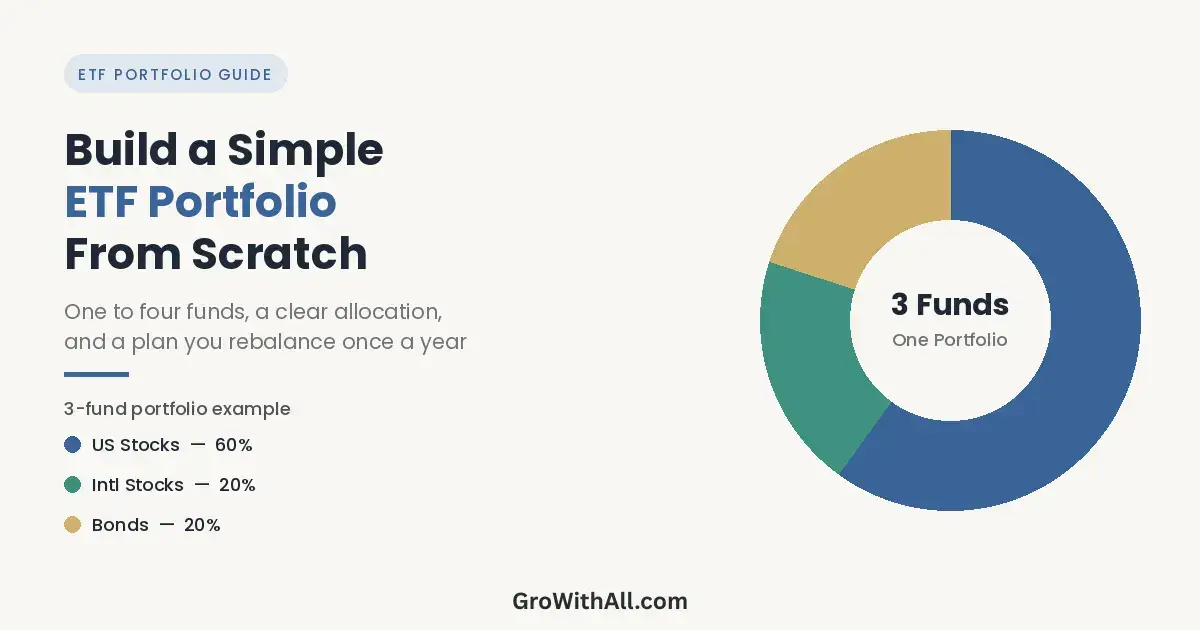
You can build a solid ETF portfolio with as few as one to four funds, no stock-picking skill, and less than an hour of setup time. ETFs give you instant diversification across hundreds or thousands of companies in a single purchase, which makes them one of the simplest ways to invest for the long term.
This guide walks through exactly which funds to consider, how to combine them, and how to keep the portfolio running with minimal upkeep.
What an ETF Actually Is
An ETF, short for exchange-traded fund, holds a basket of stocks, bonds, or other assets, and trades on an exchange throughout the day just like a single stock. Buying one share of a broad market ETF gives you partial ownership in every company the fund holds.
This structure solves the two biggest problems new investors face: it removes the need to research and pick individual companies, and it spreads risk across many businesses instead of concentrating it in one. A single poor-performing company inside the fund barely moves the total price, since it makes up only a small slice of the whole.
Why ETFs Work Well for a Simple Portfolio
Three features make ETFs a strong foundation for a beginner or hands-off investor.
- Low cost: Many broad-market ETFs charge an expense ratio, an annual fee taken from the fund’s assets, of well under 0.10 percent a year. A fund charging 0.03 percent costs $3 a year on a $10,000 investment.
- Instant diversification: A single ETF tracking a broad index, like the total US stock market, can hold thousands of individual companies. One purchase spreads your money across an entire economy instead of a handful of picks.
- Easy to trade: ETFs trade throughout market hours at a live price, and most major brokers now offer commission-free trading on ETFs alongside stocks.
Step 1: Decide on Your Asset Allocation
Asset allocation, the split between stocks and bonds in your portfolio, drives most of your long-term risk and return. Stocks offer higher long-term growth potential with larger short-term swings. Bonds offer steadier, lower returns with far smaller swings.
A common starting guideline subtracts your age from 110 or 120 to get a rough stock percentage. A 30-year-old following the 110 rule holds 80 percent stocks and 20 percent bonds. A 60-year-old holds 50 percent stocks and 50 percent bonds.
This rule works as a general starting point, not a fixed law. A younger investor with a high risk tolerance and decades until retirement can reasonably hold a higher stock percentage. A retiree drawing income from the portfolio often wants a larger bond cushion to reduce the impact of a market downturn early in retirement.
Step 2: Pick Your Core Stock Fund
A single broad-market stock ETF can serve as the entire stock portion of a simple portfolio.
- A total US stock market ETF holds thousands of companies across large, medium, and small businesses in one fund, giving you exposure to the full US economy.
- An S&P 500 ETF holds roughly 500 of the largest US companies, covering a large share of the total US market’s value in a more concentrated, well-known index.
- A total international stock ETF adds exposure to companies outside the USA, spreading risk across other economies and currencies.
Many simple portfolios split stock exposure 70 to 80 percent US and 20 to 30 percent international, though a single US-only fund still works well for investors who prefer maximum simplicity.
Step 3: Pick Your Bond Fund
- A total US bond market ETF holds a broad mix of government and corporate bonds across different maturities, offering steady income and a cushion against stock market swings.
- A short-term Treasury ETF holds only government bonds with shorter maturities, carrying less interest rate risk and lower long-term return potential than a broader bond fund.
A single total bond market fund covers most investors’ needs for the bond portion of a simple portfolio, without needing to pick between multiple bond fund types.
Step 4: Choose Your Portfolio Structure
Three common structures work well for a simple, low-maintenance ETF portfolio.
- One-fund portfolio: A single target-date or all-in-one asset allocation ETF holds a built-in mix of stocks and bonds that automatically shifts to become more conservative as a target year approaches. This needs no rebalancing from you at all.
- Two-fund portfolio: Pair one total stock market ETF with one total bond market ETF, split according to your target allocation. This gives you direct control over your stock-to-bond ratio with minimal complexity.
- Three or four-fund portfolio: Add a total international stock ETF and, optionally, a separate international bond ETF to the two-fund structure above. This adds more precise control over international exposure at the cost of slightly more rebalancing work.
A one-fund or two-fund structure suits most people well, especially in the early years of investing, when simplicity keeps you consistent.
Sample Simple ETF Portfolios
Aggressive growth portfolio (age 25-35 range):
- 70 percent total US stock market ETF
- 20 percent total international stock ETF
- 10 percent total US bond market ETF
Balanced growth portfolio (age 40-50 range):
- 50 percent total US stock market ETF
- 20 percent total international stock ETF
- 30 percent total US bond market ETF
Conservative portfolio (approaching or in retirement):
- 30 percent total US stock market ETF
- 15 percent total international stock ETF
- 55 percent total US bond market ETF
Adjust these starting points based on your own risk tolerance, timeline, and any other income sources, like a pension or Social Security, that reduce your need to draw heavily on stock market growth.
Step 5: Open the Right Account and Buy Your Funds
Choose an account type before buying, since this shapes your tax treatment. A Roth IRA or traditional IRA suits money meant for retirement. A taxable brokerage account suits money you may need before retirement age, with full flexibility and no contribution limit.
Most major brokers let you buy ETF shares, including fractional shares at many providers, with no minimum investment and no trading commission. Place your first purchase according to your chosen allocation, and set up an automatic recurring investment to keep building the portfolio in the months and years ahead.
Step 6: Rebalance on a Schedule
Over time, different funds grow at different rates, and your actual allocation drifts away from your target. A portfolio that started at 70 percent stocks and 30 percent bonds might grow to 80 percent stocks after a strong stock market run, quietly increasing your risk beyond your original plan.
Rebalancing means selling a portion of the funds that have grown beyond their target percentage and buying more of the funds that have fallen below target, bringing the mix back in line.
Check your allocation once or twice a year, and rebalance if any fund drifts more than 5 percentage points from its target. Many investors rebalance simply by directing new contributions toward whichever fund sits below target, avoiding the need to sell existing shares at all.
Common Mistakes When Building an ETF Portfolio
- Buying too many overlapping funds: Several different total market funds from different providers often hold nearly identical companies. This adds complexity without adding real diversification.
- Chasing last year’s best-performing sector: A fund that outperformed last year may lag next year, and building a portfolio around recent winners often backfires over the long run.
- Ignoring the bond allocation entirely: A portfolio with no bonds at all can swing sharply during a downturn, which can be difficult to hold through, especially close to a point when you need the money.
- Trading too often: Buying and selling ETFs frequently in response to news or short-term price moves tends to hurt long-term returns more than it helps, and adds unnecessary trading activity.
- Never rebalancing: A portfolio left completely untouched for years can drift far from its original risk level, often becoming far more aggressive than intended after a long stock market rally.
How Fees Compound Over Time
A small difference in expense ratio compounds into a large dollar difference over a multi-decade investing period.
Consider two investors, each starting with $50,000 and adding $500 a month for 30 years, earning an identical 7 percent average annual return before fees. One investor pays a 0.05 percent expense ratio. The other pays a 0.75 percent expense ratio. The lower-cost investor ends up with tens of thousands of dollars more at the end of the 30-year period, purely from the fee difference, since fees compound against the balance the same way returns compound in your favor.
Check the expense ratio of every fund before buying, listed on the fund provider’s website and inside your broker’s fund research page. A difference that looks small on paper, like 0.05 percent versus 0.50 percent, becomes meaningful once compounded across decades.
Tax Efficiency Across Account Types
Where you hold each fund matters almost as much as which funds you pick, once you use more than one account type.
Bond funds tend to generate more regular taxable income than broad stock index funds, which mostly grow through price appreciation and a smaller stream of dividends. Holding bond funds inside a tax-advantaged account, like a traditional or Roth IRA, shields that regular income from yearly taxation. Holding broad stock index funds in a taxable account often works well, since these funds tend to generate less taxable activity year to year and qualify for lower long-term capital gains rates when eventually sold.
International stock funds sometimes carry a foreign tax credit that offsets a portion of foreign taxes withheld on dividends, a credit that only applies when the fund sits in a taxable account rather than an IRA. This detail matters more for larger portfolios spread across several account types, and less for a single retirement account holding all your funds together.
A retiree or investor withdrawing money regularly should weigh the order of withdrawals across taxable, traditional, and Roth accounts, too, since this order affects the total tax paid over a multi-decade retirement. A financial advisor or tax professional can help map out a withdrawal sequence suited to your specific accounts and tax bracket.
Frequently Asked Questions
How many ETFs do I need for a diversified portfolio?
A single total-market or target-date ETF can provide full diversification on its own. A two to four-fund combination gives more precise control over your stock, bond, and international mix without adding unnecessary complexity.
Are ETFs safer than individual stocks?
An ETF spreads risk across many companies, which reduces the impact of any single company’s poor performance compared to holding that one stock alone. An ETF still carries overall market risk and can lose value during a broad market downturn.
What is the difference between an ETF and a mutual fund?
Both hold a basket of investments, but an ETF trades throughout the day at a live market price. A traditional mutual fund only prices once per day after markets close. ETFs tend to carry lower minimum investments, too, and in many cases, lower expense ratios.
How much money do I need to start an ETF portfolio?
Many brokers offer ETFs with no account minimum, and fractional share trading lets you start with as little as $1 to $100. The size of your first purchase matters far less than starting the habit of regular contributions.
Should I pick actively managed ETFs or index ETFs?
Index ETFs track a market benchmark at a low cost and tend to outperform the majority of actively managed funds over long periods, after fees. Most simple, low-maintenance portfolios rely primarily on low-cost index ETFs for this reason.
The Bottom Line
Building a simple ETF portfolio from scratch takes a handful of decisions: your stock-to-bond split, one or two core stock funds, one core bond fund, and a plan to rebalance once or twice a year. A one-fund or two-fund structure keeps the process manageable. Low expense ratios and regular contributions do the real work of building wealth over time. Set your allocation, automate your contributions, and let the portfolio run with minimal ongoing effort.
