
You can start investing in stocks with $100 today. Most major brokers now offer commission-free trades and fractional shares, so a small amount buys a real stake in companies that used to cost thousands of dollars a share.
This guide walks through exactly where to put that $100, which account to open, and how to grow the habit from a single deposit into a long-term plan.
Yes, $100 Is Enough to Start
A generation ago, a new investor needed enough money to buy at least one full share of a company, and enough extra cash to cover a trading commission on top of that. Both barriers are gone for most investors today.
Fractional shares let you buy a slice of an expensive stock, like a $500 share, for as little as $1. Commission-free trading, now standard at most major brokers, means your full $100 goes toward buying shares instead of paying fees. The real advantage of starting now, even with a small amount, is time. Money invested at 25 has decades longer to grow than the same amount invested at 45.
Step 1: Pick the Right Account Type
Before buying a single share, choose the account that holds your investments.
- A taxable brokerage account offers full flexibility. You can deposit and withdraw money at any time, and there is no limit on how much you can contribute each year. Gains face capital gains tax when you sell at a profit.
- A Roth IRA grows tax-free, and qualified withdrawals in retirement owe no tax at all. Contributions are limited each year by IRS rules, and the account works best for money you do not need until retirement age.
- A traditional IRA offers a tax deduction on contributions in many cases, with taxes owed on withdrawals in retirement instead. This account carries its own annual contribution limit set by the IRS, too.
A first-time investor with $100 to start often does well with a taxable brokerage account for flexibility, or a Roth IRA if the money is meant for long-term retirement savings and you want tax-free growth for decades.
Step 2: Choose a Broker With No Minimums and No Fees
Look for three features when picking a broker as a beginner: no account minimum, no trading commissions on stocks and ETFs, and fractional share support.
Most major brokers in the USA now meet all three standards, including Fidelity, Charles Schwab, and Vanguard, along with newer app-based platforms. Compare the specific investment options each broker offers, since some limit fractional shares to a smaller list of stocks and funds.
Opening an account usually takes about ten minutes online. You will need your Social Security number, a bank account for funding, and basic employment information.
Step 3: Decide Between Individual Stocks and Funds
A $100 investment can go toward a single stock, several individual stocks split into smaller pieces, or a fund that holds hundreds of stocks at once.
- Individual stocks let you pick specific companies you believe in, but concentrate your risk in a small number of businesses. A single bad quarter at one company can swing your entire $100 investment sharply.
- Index funds and ETFs spread your $100 across many companies at once. An S&P 500 index fund, for example, holds a slice of roughly 500 large US companies in a single purchase. This diversification smooths out the ups and downs of any single company.
Most first-time investors build a stronger foundation with a broad index fund first, then add individual stocks later as they learn more and have more money to allocate toward specific research and risk-taking.
Step 4: Build a Simple Starting Portfolio
A $100 starting investment does not need to be complicated. Three common approaches work well for beginners.
- Single fund approach: Put the full $100 into one broad index fund, such as a total US stock market fund or an S&P 500 fund. This gives instant diversification in one purchase.
- Two-fund approach: Split $100 between a US stock index fund and an international stock index fund, often in a 70/30 or 80/20 split, to add exposure outside the USA.
- Target-date fund approach: Put the full $100 into a single target-date fund matched to your expected retirement year. This fund automatically adjusts its mix of stocks and bonds as you age, and needs no further rebalancing from you.
Pick the approach that matches how much time you want to spend managing your investments. A single fund or target-date fund needs almost no ongoing maintenance, which suits most beginners well.
Step 5: Automate Future Contributions
A single $100 deposit is a strong start, but the real growth comes from adding to it regularly. Set up an automatic transfer from your checking account into your brokerage account, timed right after each paycheck.
Even a modest recurring amount, like $50 or $100 a month, compounds meaningfully over time. Automation removes the temptation to skip a month or spend the money elsewhere, and it takes advantage of dollar-cost averaging, buying shares at a mix of prices over time rather than trying to time the market.
Understanding Risk With a Small Starting Amount
A $100 investment carries the same percentage risk as a $100,000 investment. The dollar amount at stake just feels smaller. Stock prices can and do drop 20 percent or more during a market downturn, and a diversified portfolio still moves up and down with the broader market.
This risk is exactly why a long time horizon matters so much for a new investor. Historically, the US stock market has recovered from every prior downturn and gone on to reach new highs, though this recovery has sometimes taken several years. Money you will not need for five, ten, or more years can ride out this volatility far more comfortably than money you need next year.
Keep a separate emergency fund outside your investment account, ideally covering three to six months of expenses, before putting extra money into stocks. This keeps a market downturn from forcing you to sell investments at a loss to cover an unexpected bill.
What $100 Actually Buys You Today
A single share of some well-known companies costs several hundred or even a few thousand dollars. Fractional share trading solves this problem directly. Instead of needing the full share price, you tell your broker a dollar amount, such as $25, and you receive a matching slice of ownership.
This means $100 can buy a small piece of four different companies, a full fractional stake in one expensive stock, or a complete share of a fund priced under $100. The mechanics work the same as buying a whole share: you own a real, proportional claim on that company’s future earnings and any dividends it pays, scaled to the size of your purchase.
Dividends on fractional shares get paid out in the same proportion as your ownership stake. A fractional holding worth one-tenth of a share receives one-tenth of that per-share dividend payment, deposited straight into your account.
Investing $100 for a Teen or Young Adult
Custodial brokerage accounts let a parent or guardian open and manage an investment account on behalf of a minor, with the funds becoming the minor’s property once they reach the age of majority in their state, usually 18 or 21.
A custodial account works well for a first $100 gift or allowance redirected toward long-term growth instead of daily spending. The tax treatment differs slightly from an adult account, with a portion of investment income taxed at the child’s own tax rate and amounts above certain thresholds taxed at the parent’s rate, so check current IRS rules before opening one.
Starting this habit early gives a young investor a head start that is difficult to match later. A single $100 investment at age 16, left untouched and growing at a long-term historical average return, can grow substantially larger by retirement age than the same amount invested decades later in adulthood.
Common Mistakes New Investors Make
- Trying to pick winning stocks with no research: A stock tip from social media or a friend is not a substitute for understanding what a company does and why its price might grow.
- Checking the account balance every day: Daily price swings mean little for a long-term investor, and constant checking often leads to emotional decisions like selling during a normal dip.
- Panic selling during a downturn: Selling after a price drop locks in the loss and misses the recovery that has followed every prior downturn in US market history.
- Putting all $100 into one small, unproven company: A broad fund spreads risk across hundreds of companies. A single small stock carries far more risk of a total loss.
- Ignoring fees inside funds: Look at a fund’s expense ratio before buying. A fund charging 0.03 percent a year costs far less over decades than one charging 0.75 percent, and both numbers look small at first glance.
How Compounding Works in Your Favor
A single $100 investment growing at an average 8 percent annual return, a rough long-term historical average for a diversified US stock portfolio, grows to roughly $470 after 20 years with no further contributions at all.
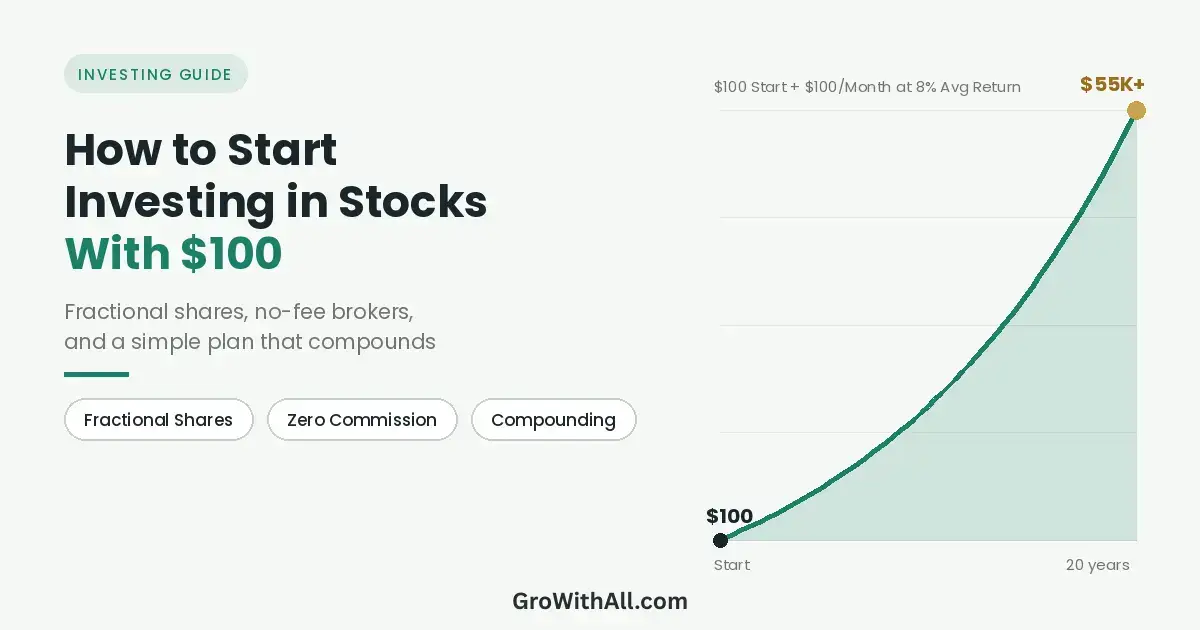
Add a recurring $100 monthly contribution to that same starting amount, and the total grows to well over $55,000 after 20 years at the same 8 percent average return. The bulk of this growth comes from the contributions and compounding, not the original $100, which shows why starting the habit matters more than the size of the first deposit.
Past returns do not guarantee future results, and any given year can land well above or below this long-term average. The pattern holds over long stretches of market history, though no single year or decade is guaranteed to match it.
Sample Growth of a $100 Start Plus Monthly Contributions
| Years Invested | $100 Start, No Added Contributions | $100 Start Plus $100/Month |
|---|---|---|
| 5 years | $147 | $7,530 |
| 10 years | $216 | $18,750 |
| 20 years | $466 | $55,300 |
| 30 years | $1,006 | $147,600 |
These figures assume an 8 percent average annual return and do not account for taxes, fees, or inflation, all of which reduce the real, spendable value of the final total.
When to Move Beyond $100
Once your first $100 is invested and your automatic contributions are running, a few next steps help build a stronger long-term plan.
Increase your contribution rate whenever your income grows, such as after a raise or a new job. Even a small percentage increase, redirected straight into investments before it reaches your regular spending, adds up over a career.
Diversify further as your balance grows, adding exposure to bonds for stability or additional stock sectors for growth, based on your risk tolerance and time horizon. Review your account once or twice a year, rebalancing if one holding has grown to take up a much larger share of your portfolio than intended.
Frequently Asked Questions
Can I really buy stocks with only $100?
Yes. Fractional shares and commission-free trading at most major brokers mean $100 buys real ownership in one stock, several stocks, or a diversified fund, without needing to afford a full share price or pay a trading fee.
What is the best stock to buy with $100?
A broad index fund, such as one tracking the S&P 500 or the total US stock market, gives new investors instant diversification and historically strong long-term returns, rather than betting the full amount on a single company.
Should I invest $100 or pay off debt first?
High-interest debt, such as a credit card charging 20 percent or more, usually costs more than a diversified stock portfolio earns on average. Pay down high-interest debt first, then direct new money toward investing once that debt is cleared.
How much money do I need to start investing?
Many major brokers have no account minimum at all, and fractional shares let you start with as little as $1. The habit of investing regularly matters more than the size of your first deposit.
Is investing $100 in stocks safe?
Stocks carry real risk of short-term loss, and prices can drop sharply during a downturn. A diversified fund reduces single-company risk, and a long time horizon gives your investment more room to recover from any short-term drop.
The Bottom Line
Starting to invest in stocks with $100 is fully possible today, thanks to fractional shares and commission-free trading at nearly every major broker. Open a brokerage or Roth IRA account, choose a broad, diversified fund for your first purchase, and automate future contributions so the habit continues past the first deposit. The size of your first $100 matters far less than the decades of compounding that follow it.
