
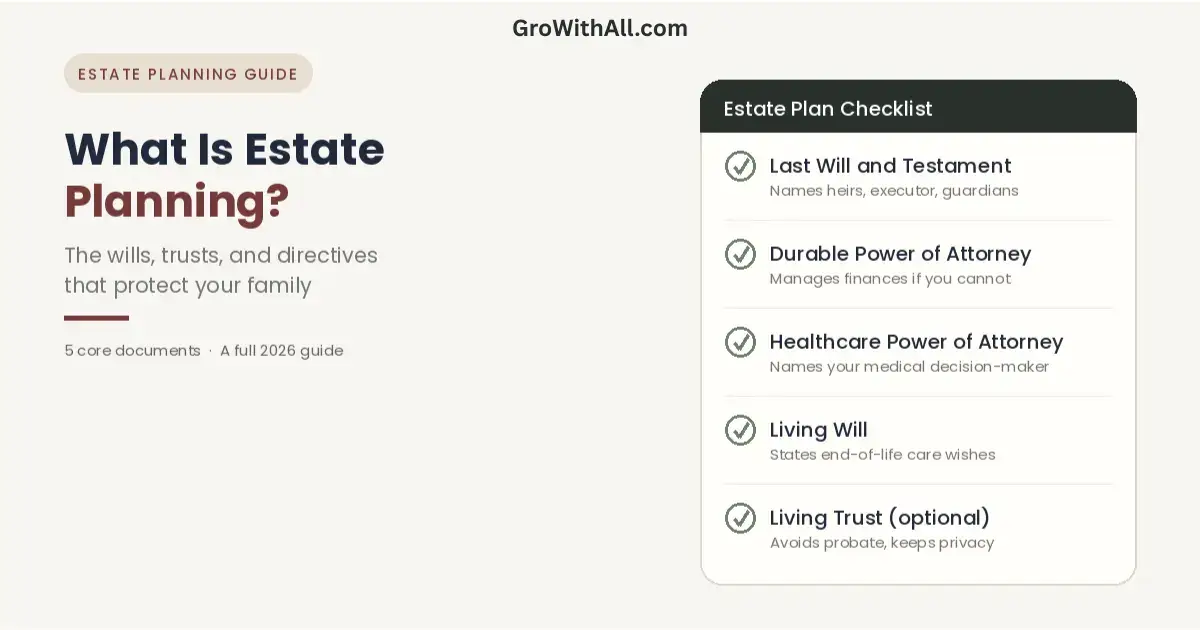
Estate planning is the process of deciding who receives your money, property, and belongings after you die, and who makes decisions for you if you cannot make them yourself. A full plan usually includes a will, a power of attorney, a healthcare directive, and, for many households, a trust.
This guide walks through every core document, when you need each one, and the steps to build a plan that actually works.
Why Estate Planning Matters at Any Age
Estate planning is not just for the wealthy or the elderly. A 30-year-old with a bank account, a car, and a child needs a plan just as much as a 70-year-old with a large portfolio.
Without a plan, state law decides who gets your property, who raises your minor children, and who makes medical decisions on your behalf if you cannot speak for yourself. These default rules rarely match what you would choose, and they often add cost, delay, and stress for the people you leave behind.
A basic plan takes a few hours to build with the right guidance and can prevent months of court proceedings and family conflict later.
The Core Documents Every Estate Plan Needs
Five documents form the foundation of most estate plans in the USA.
1. Last Will and Testament
A will names who receives your property, names a guardian for minor children, and names an executor to carry out your wishes. Without a will, state intestacy law decides these questions for you, often in ways you would not choose.
A will only takes effect after death and only controls property that does not already have a named beneficiary or joint owner. Bank accounts, retirement accounts, and life insurance policies pass directly to their named beneficiaries, regardless of what a will says.
2. Durable Power of Attorney
A durable power of attorney names a person to manage your financial affairs if illness or injury leaves you unable to act. This person can pay bills, manage accounts, and handle property on your behalf.
Without this document, your family may need to petition a court for guardianship or conservatorship to gain legal authority over your finances, a process that costs money and takes weeks or months to complete.
3. Healthcare Power of Attorney
A healthcare power of attorney names a person to make medical decisions for you if you cannot make them yourself. This person works alongside your medical team when you face a serious illness or injury and cannot communicate your wishes directly.
Pick someone who knows your values and can act calmly under pressure. This role often falls to a spouse, an adult child, or a close sibling.
4. Living Will or Advance Directive
A living will states your wishes for end-of-life medical care, including whether you want life support, artificial nutrition, or other interventions in specific situations. This document guides your healthcare agent and your medical team when hard decisions arise.
Without this document, family members may disagree sharply about your care, often during an already difficult moment.
5. Beneficiary Designations
Beneficiary forms on retirement accounts, life insurance policies, and payable-on-death bank accounts override what a will says. These forms name who receives that specific asset directly, without going through probate court.
Review these forms every few years, and after every major life event: marriage, divorce, a new child, or the death of a named beneficiary. An outdated beneficiary form can send an account to an ex-spouse or a person you no longer intend to benefit.
Do You Need a Trust?
A trust is a legal arrangement that holds property on behalf of beneficiaries, managed by a person or institution called a trustee. Trusts serve several purposes beyond simple asset transfer.
- A revocable living trust lets you control your property during your lifetime, then passes it to your chosen beneficiaries without going through probate court. This can save months of court time and keep your affairs private, since probate records become public but trust administration does not.
- An irrevocable trust removes assets from your direct control and often your taxable estate, which can reduce estate tax exposure for larger estates and offer protection from certain creditors.
- A special needs trust holds assets for a beneficiary with a disability without disqualifying them from means-tested government benefits like Medicaid or Supplemental Security Income.
A trust makes the most sense if you own real estate in more than one state, want to avoid probate, have a beneficiary who needs asset protection, or have an estate large enough to face federal or state estate tax. A simple will often covers the needs of a smaller, single-state estate.
Understanding Probate
Probate is the court process that validates a will, pays remaining debts, and transfers property to beneficiaries. Every state runs its own probate process, and timelines vary widely.
A simple, uncontested probate case can wrap up in a few months. A larger or contested estate can take a year or more and rack up legal fees, court costs, and executor fees along the way, often totaling several percent of the total estate value.
Assets held in a properly funded living trust, accounts with named beneficiaries, and jointly owned property with survivorship rights all bypass probate entirely. This is the main reason many people build a trust alongside or instead of a simple will.
Estate and Inheritance Taxes
The federal estate tax only applies to estates above a high exemption threshold, which sits in the tens of millions of dollars per person as of recent tax law and adjusts periodically for inflation. Most households in the USA never owe federal estate tax.
A handful of states levy their own estate or inheritance tax with a much lower exemption threshold than the federal level, sometimes starting around $1 million to $2 million in total estate value. Check your specific state’s rules if your estate approaches these lower thresholds, since state-level tax can apply even when federal tax does not.
An inheritance tax, charged in a small number of states, falls on the person receiving the inheritance rather than on the estate itself, and the rate often depends on the relationship between the deceased and the beneficiary.
Planning for Minor Children
Parents of minor children carry an added responsibility in estate planning: naming a guardian. Without a named guardian in a will, a court decides who raises your children if both parents die, based on state law and the court’s judgment of the child’s best interest.
Name both a primary and a backup guardian, and talk with the people you choose before finalizing the documents. A surprised guardian, thrust into the role without warning, faces a much harder transition than one who agreed to the responsibility in advance.
Consider a trust to hold and manage assets for minor children rather than leaving property directly to them. Most states do not allow minors to control real property or large sums directly, and a court-supervised arrangement, without a trust in place, adds cost and oversight that a well-drafted trust avoids.
How Often to Update Your Estate Plan
An estate plan is not a one-time task. Review your documents every three to five years, and immediately after major life events:
- Marriage or divorce
- Birth or adoption of a child
- Death of a named executor, trustee, or beneficiary
- A large change in assets, such as buying a business or receiving an inheritance
- A move to a new state, since estate laws vary and some documents may need updated language
An outdated plan can name a person who has since died, leave out a child born after the documents were signed, or fail to reflect a divorce, all of which can create confusion and conflict at the worst possible time.
Steps to Build Your Estate Plan
- List your assets and debts: Include bank accounts, retirement accounts, real estate, life insurance, and any business interests.
- Decide who inherits what: Name specific people or organizations for specific assets, or set percentage splits for the overall estate.
- Choose your key people: Pick an executor, a financial power of attorney agent, a healthcare agent, and guardians for minor children if needed.
- Meet with an estate planning attorney: State laws vary, and a local attorney can draft documents that hold up under your state’s specific requirements.
- Fund your trust, if you create one: A trust only controls assets that are formally retitled into its name. An unfunded trust does nothing for probate avoidance.
- Store your documents safely: Keep originals in a secure but accessible location, and give copies or at least the location information to your executor and agents.
- Review and update regularly: Set a calendar reminder every few years, and revisit sooner after any major life change.
Common Estate Planning Mistakes
- Relying only on a verbal promise: Courts follow written, properly executed documents, not spoken intentions shared with family members.
- Naming only one person for a role with no backup: A named executor, agent, or guardian who dies or becomes unavailable leaves a gap that a backup choice would have filled.
- Forgetting to fund a trust: Creating a trust document without retitling assets into the trust’s name leaves those assets subject to probate anyway.
- Using a generic online template for a complex estate: A template can work for a very simple estate, but a blended family, a business, or large assets spread across multiple states often need customized legal language.
- Never updating the plan: Life changes fast. A plan drafted a decade ago may no longer reflect your family, your assets, or your wishes.
Digital Assets and Online Accounts
Modern estate planning now covers more than physical property and bank accounts. Email accounts, social media profiles, cryptocurrency wallets, and cloud-stored photos all need a plan too.
Many platforms require a specific legal process or a named digital executor before family members can access or close an account after death. List your major digital accounts, note where passwords are stored, such as a password manager, and name someone you trust to handle this part of your estate.
Cryptocurrency holdings need particular care. Unlike a bank account, a lost private key or seed phrase can make funds permanently unreachable, even for a named executor with full legal authority. Store recovery information securely, and tell your executor or a trusted person where to find it.
Frequently Asked Questions
Do I need a lawyer for estate planning?
A lawyer is not legally required for a basic will in most states, but professional guidance helps avoid errors that can invalidate a document or create ambiguity that leads to disputes. Complex estates, blended families, or business ownership all benefit strongly from legal review.
What happens if I die without a will?
State intestacy law decides who inherits your property, typically following a fixed order of spouse, children, parents, and siblings. This process rarely reflects a person’s actual wishes and can take longer and cost more than a plan built in advance.
Is a living trust better than a will?
A trust avoids probate and keeps your affairs private. A will alone goes through probate court. Many people use both together: a trust for major assets, and a simple will as a backup to catch anything left out of the trust.
How much does estate planning cost?
A basic will and power of attorney package often costs several hundred to a couple thousand dollars through an attorney, depending on your state and complexity. A full trust-based plan typically costs more, often in the low thousands of dollars, though this cost often saves far more in avoided probate fees and delays.
Can I write my own will without a lawyer?
Many states recognize a self-written or template-based will if it meets state-specific signing and witnessing requirements. The risk grows with the complexity of your estate, so a simple, single-person estate carries less risk than a blended family or business-owning household.
The Bottom Line
Estate planning gives you control over who receives your property, who raises your children, and who makes decisions on your behalf if you cannot. A complete plan includes a will, powers of attorney, a healthcare directive, and often a trust, built around your specific family and assets. Build the plan now, fund any trust you create, name backups for every key role, and revisit the documents every few years so they keep matching your real life.
