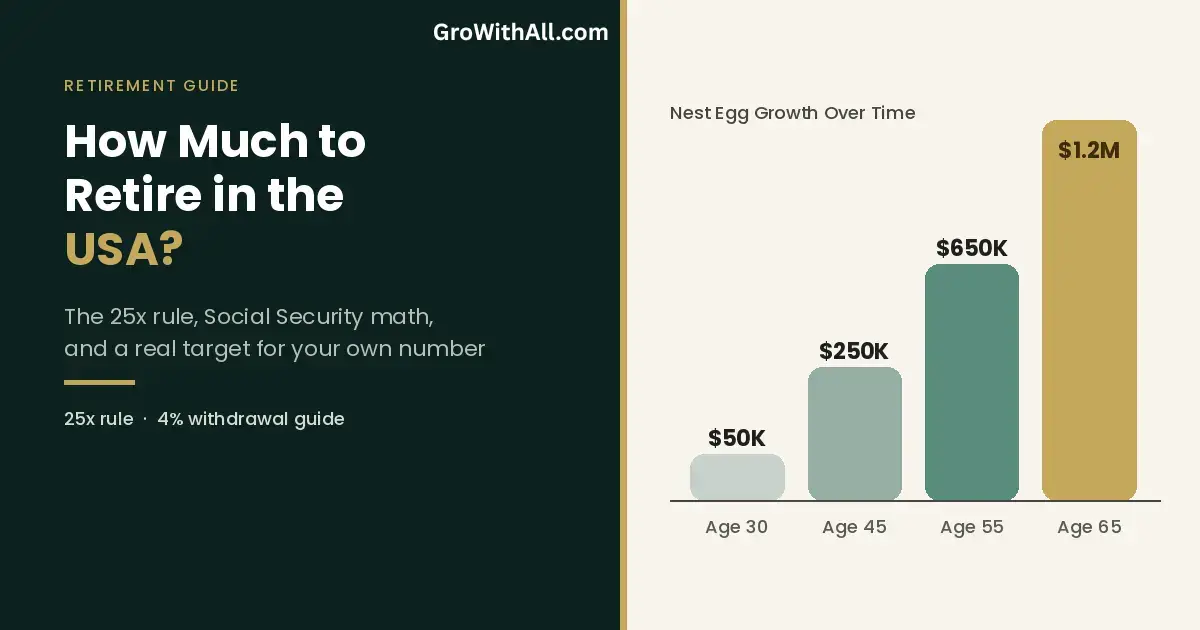
Most financial planners point to a range between $1 million and $1.5 million for a comfortable retirement in the USA, though the real number depends on your location, your lifestyle, and the age you plan to stop working. A simpler rule, the 25x rule, says to save 25 times your expected annual spending.
This guide breaks down the math, the rules of thumb, and the steps to build a number that fits your own life.
The Short Answer: Your Number Comes From Your Spending, Not a Fixed Figure
A retirement number is not one figure that fits every household. A retiree spending $40,000 a year needs a far smaller nest egg than a retiree spending $100,000 a year. Location, health, and family support all shift the target up or down.
Start with your expected yearly spending in retirement, not your current income. Many people spend less once the mortgage is paid off and work costs disappear. Others spend more on travel and healthcare. Build your number from real expected costs, not a guess.
The 25x Rule Explained
The 25x rule comes from the 4 percent withdrawal guideline. Multiply your expected annual spending by 25, and you get a nest egg that can, in theory, support that spending for 30 years without running out.
A retiree who plans to spend $50,000 a year needs $1,250,000 under this rule. A retiree spending $70,000 a year needs $1,750,000. The math scales directly with your spending target.
This rule works as a starting point, not a guarantee. Market downturns, unexpected medical costs, and a longer-than-expected lifespan can all strain a portfolio built on this formula alone.
The 4 Percent Withdrawal Rule
The 4 percent rule says a retiree can withdraw 4 percent of their portfolio in year one, then adjust that dollar amount for inflation each following year, with a strong chance the money lasts 30 years.
A $1,000,000 portfolio under this rule supports a $40,000 withdrawal in year one. That amount then rises with inflation each year after. Historical data from past market cycles backs this rule for many 30-year periods, though a handful of worse-case periods, like the 1960s stagflation era, tested this rule harder.
Some planners now suggest a more conservative 3.3 to 3.5 percent starting rate, given longer average lifespans and years of low bond yields. A lower starting rate means a larger required nest egg for the same spending level.
How Social Security Changes the Math
Social Security reduces the amount you need to draw from savings each year. The average monthly Social Security retirement benefit sits near $1,900, according to Social Security Administration data. Your own benefit amount changes with your earnings history and the age you start claiming.
Claiming at age 62 locks in a permanently reduced benefit. Waiting until your full retirement age, 66 or 67 for most workers today, gets you 100 percent of your calculated benefit. Waiting past full retirement age, up to age 70, adds roughly 8 percent per year in delayed credits.
A couple receiving a combined $4,000 a month from Social Security covers $48,000 of annual spending before touching a single dollar of savings. This benefit can cut a required nest egg by hundreds of thousands of dollars compared to a retiree with no Social Security income at all.
Retirement Costs by Lifestyle Level
Three rough lifestyle tiers help frame the target number.
- Modest lifestyle, roughly $40,000 to $50,000 a year: Covers housing, food, basic healthcare, and limited travel. Often achievable with $800,000 to $1,000,000 in savings plus Social Security.
- Comfortable lifestyle, roughly $60,000 to $80,000 a year: Covers a paid-off home, regular travel, hobbies, and a buffer for healthcare costs. Often needs $1,200,000 to $1,800,000 in savings plus Social Security.
- Upscale lifestyle, $100,000 a year or more: Covers multiple trips a year, a larger home, and higher discretionary spending. Often needs $2,000,000 or more in savings plus other income sources.
These figures shift with your location. A retiree in a low-cost state like Mississippi or Oklahoma can stretch a smaller nest egg much further than a retiree in California or New York.
Healthcare Costs in Retirement
Healthcare ranks among the largest and least predictable retirement costs. Fidelity’s annual retiree healthcare estimate puts the average 65-year-old couple’s lifetime healthcare and medical costs in retirement above $300,000, even with Medicare coverage in place.
Medicare starts at age 65 and covers a large share of costs, but it does not cover everything. Premiums for Part B and Part D, plus supplemental coverage, dental, vision, and hearing costs, and any long-term care needs, all fall outside standard Medicare coverage.
Budget a specific healthcare line item separate from daily living costs. A retiree who folds healthcare into a general spending estimate often underestimates the true cost by a wide margin.
How Age at Retirement Changes Your Target
Retiring earlier means your savings need to stretch across more years and cover a longer gap before Social Security and Medicare kick in.
A person retiring at 55 needs savings to bridge 10 years before Social Security eligibility and 10 years before Medicare eligibility. This bridge period often needs a larger separate cash reserve, since early withdrawal penalties apply to most retirement accounts before age 59 and a half.
A person retiring at 67, full retirement age for many workers, faces a shorter bridge gap and can claim full Social Security and Medicare benefits right away. Every year you delay retirement past your planning age both shrinks the required savings period and adds another year of contributions and growth.
Building Your Own Retirement Number
Follow these steps to build a target that fits your actual life, not a generic average.
- Estimate your annual retirement spending: Start with current spending, subtract costs that disappear, like a mortgage or commuting costs, and add costs that grow, like healthcare and travel.
- Subtract expected Social Security income: Use the Social Security Administration’s online estimator for a number based on your real earnings record.
- Subtract any pension income: Government workers and some private-sector employees still receive a fixed pension that covers part of retirement spending.
- Multiply the remaining gap by 25: This gives you a target nest egg using the 25x rule, adjusted for your own guaranteed income sources.
- Add a healthcare buffer: Layer in a separate reserve for out-of-pocket medical costs beyond Medicare.
- Revisit the number every few years: Spending needs, health, and market conditions all shift over a working career, so treat this as a living target, not a one-time calculation.
Inflation and the Long Arc of Retirement Spending
A retirement plan built for today’s prices alone falls apart over a 20 or 30-year stretch. Inflation, even at a modest average rate of 3 percent a year, roughly doubles the cost of everyday goods and services within 24 years.
This means a retiree spending $60,000 in year one of retirement may need close to $108,000 to buy the same basket of goods and services by year 20, purely from price increases. A fixed nest egg that ignores this growth runs dry far sooner than the owner expects.
Build inflation directly into your withdrawal plan. The 4 percent rule already accounts for this by raising the dollar amount withdrawn each year to match inflation, not by holding the withdrawal flat. Any retirement calculator you use should show real, inflation-adjusted numbers, not today’s dollars carried forward untouched.
Where to Hold Your Retirement Savings
The account type you use shapes both your tax bill and your flexibility in retirement.
A traditional 401(k) or IRA grows tax-deferred, and withdrawals count as ordinary income in retirement. A Roth 401(k) or Roth IRA grows tax-free, and qualified withdrawals owe no tax at all. A taxable brokerage account offers full flexibility with no withdrawal rules, though gains face capital gains tax along the way.
Most retirees benefit from a mix of all three. Traditional accounts often make sense during peak earning years, when the tax deduction carries real value. Roth accounts make sense for a portion of savings you expect to need in a higher future tax bracket, or for money you want to pass on without a tax bill for your heirs. A taxable account fills gaps for spending before retirement account withdrawals make sense, and it avoids the early withdrawal penalties that apply to most retirement accounts before age 59 and a half.
Common Mistakes That Throw Off the Number
- Using current income instead of expected spending: Income and spending rarely match exactly, and retirement planning built on the wrong figure misses the real target.
- Ignoring inflation over a multi-decade retirement: A 30-year retirement at even modest inflation roughly doubles the cost of living by the end of the period. A plan that only accounts for today’s prices falls short by the later years.
- Skipping a tax analysis: Withdrawals from a traditional 401(k) or IRA count as taxable income. A retiree drawing $60,000 from a traditional account keeps less than a retiree drawing the same amount from a Roth account, so tax treatment changes how much you actually need saved.
- Underestimating longevity: A 65-year-old today has a real chance of living past 90, and planning for a shorter retirement risks running out of money in the later years, when income options narrow.
- Forgetting one-time costs: A new roof, a car replacement, or a health event can hit a retirement budget hard if the plan only accounts for steady monthly spending.
How Much Should You Save Each Year Before Retirement
Most guidance points to saving 15 percent of gross income throughout a full career, including any employer match, to reach a comfortable retirement target by a traditional retirement age.
Starting later in a career needs a higher savings rate to catch up. A worker starting serious retirement saving at age 45 often needs to save 20 percent or more of income to reach the same target as a worker who started at 25 saving 15 percent.
Employer 401(k) matches count as part of this savings rate and represent free money left on the table if skipped. Contribute at least enough to capture the full employer match before directing extra savings elsewhere.
Sample Retirement Targets by Spending Level
| Annual Spending Need | Social Security Income | Savings Gap to Cover | Target Nest Egg (25x Gap) |
|---|---|---|---|
| $50,000 | $24,000 | $26,000 | $650,000 |
| $70,000 | $30,000 | $40,000 | $1,000,000 |
| $90,000 | $36,000 | $54,000 | $1,350,000 |
| $120,000 | $40,000 | $80,000 | $2,000,000 |
These figures serve as a starting model, not a guarantee. Run your own numbers with your real expected Social Security benefit and spending plan.
Frequently Asked Questions
Is $1 million enough to retire in the USA?
For many households with a modest to comfortable lifestyle and a Social Security benefit, $1 million supports a withdrawal in the $40,000 to $60,000 range each year. For a higher-spending lifestyle or an early retirement, $1 million may fall short.
What is the average retirement savings by age?
Federal Reserve survey data shows retirement account balances vary widely by age and income, with median balances far below the levels needed for a comfortable retirement at typical spending levels. This gap is why building a personal number matters more than comparing to a national average.
Can I retire with no savings, using only Social Security?
Social Security alone covers basic needs for some retirees in low-cost areas, but the average benefit falls short of covering a comfortable lifestyle without other savings, a pension, or continued part-time income.
How does location change how much I need to retire?
Housing and healthcare costs vary sharply by state and city. A retiree in a high-cost coastal city may need double the nest egg of a retiree with the same lifestyle in a low-cost state, purely from housing and tax differences.
Should I pay off my mortgage before retiring?
A paid-off mortgage lowers your required monthly spending and reduces the size of the nest egg needed under the 25x rule. Weigh this against the interest rate on your mortgage and any investment returns you would give up by directing extra cash toward payoff instead of savings.
The Bottom Line
The amount you need to retire in the USA comes down to your expected spending, your Social Security and pension income, and the number of years your savings need to last. The 25x rule and the 4 percent withdrawal guideline give a solid starting framework, but your real number depends on your location, your health, and the lifestyle you plan to live. Build your target from real numbers, add a healthcare buffer, and revisit the plan every few years as your life and the markets change.