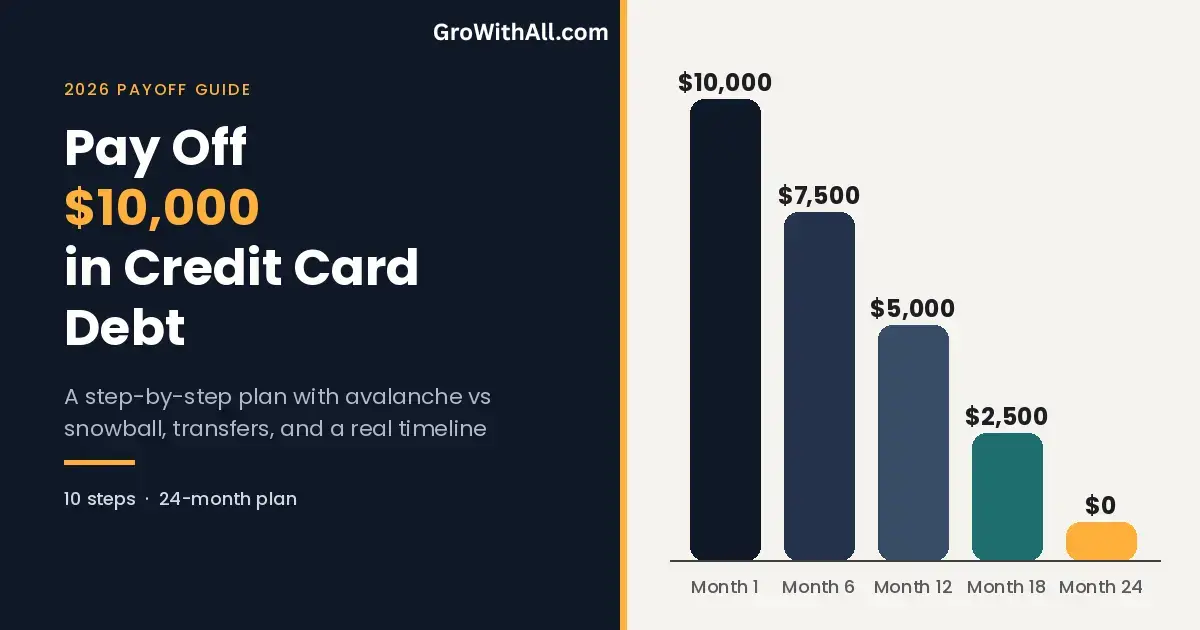
Paying off $10,000 in credit card debt takes a plan, a clear payoff date, and steady payments above the minimum. Most borrowers clear this amount in 24 to 48 months once they pick a payoff method, cut new spending, and put every spare dollar toward the balance.
This guide walks through the math, the methods, and the exact steps to get to a zero balance.
Why $10,000 in Credit Card Debt Feels So Heavy
Credit cards carry some of the highest interest rates of any common debt. The average credit card APR in the USA sits near 21 percent, according to Federal Reserve data. At that rate, a $10,000 balance with only minimum payments can take over 25 years to clear and cost more than $15,000 in interest alone.
The math works against you fast. A minimum payment often covers barely more than the interest charge for that month, so the principal barely moves. Breaking this cycle takes a payment well above the minimum, applied on a fixed schedule.
Step 1: Get the Full Picture of Your Debt
List every card, its balance, its interest rate, and its minimum payment. Put this in one spreadsheet or a plain sheet of paper. You cannot build a payoff plan around numbers you have not written down.
Add up the total minimum payments across all cards. Compare that number to your monthly income after rent, utilities, and food. This tells you how much room you have to add extra payments right now.
Step 2: Pick a Payoff Method
Two proven methods work for most people: the avalanche method and the snowball method.
The avalanche method targets the card with the highest interest rate first. You pay the minimum on every other card at the same time. Once that card hits zero, you roll its payment into the card with the next highest rate. This method saves the most money in total interest.
The snowball method targets the card with the smallest balance first, regardless of rate. Once it hits zero, you roll that payment into the next smallest balance. This method costs a bit more in interest, but the fast wins keep many people motivated.
Pick avalanche if you want the lowest total cost. Pick snowball if you have struggled to stick with a payoff plan before and need quick progress to stay on track.
Step 3: Set a Real Monthly Payment Target
A $10,000 balance at 21 percent APR needs roughly $470 a month to clear in two years. Drop that payment to $320 a month, and the payoff stretches to three years and adds close to $1,500 in extra interest.
Run your own numbers with a payoff calculator, and pick a monthly payment you can sustain for the full term. A payment you abandon after three months does less good than a smaller payment you keep for two years.
Step 4: Free Up Cash in Your Budget
Most people find extra payment money by trimming a handful of categories, not by cutting everything at once.
- Cancel subscriptions you rarely use. The average household pays for several streaming or app subscriptions that go unused for months.
- Cook at home four extra nights a week. A single avoided restaurant meal can cover a meaningful chunk of a monthly card payment.
- Pause new retail purchases for 90 days. Put that budget line straight toward the balance.
- Sell items you no longer use. Electronics, furniture, and clothing in good condition sell fast on local marketplace apps.
Track where every freed-up dollar goes. Money that disappears back into daily spending does nothing for your balance.
Step 5: Consider a Balance Transfer Card
A balance transfer card moves your debt to a new card with a 0 percent introductory rate, often for 12 to 21 months. This buys you a window with no interest charges, so every payment goes straight to principal.
Most transfer cards charge a fee of 3 to 5 percent of the balance moved. On a $10,000 transfer, that fee runs $300 to $500, paid once at the start. Compare that fee against the interest you would pay at your current rate over the same window. For most people carrying a 20 percent APR, the fee costs far less than a year of interest.
Approval for a good transfer card usually needs a credit score in the good range or higher, so check your score before you apply.
Step 6: Consider a Personal Loan
A personal loan can consolidate several card balances into one fixed payment at a lower rate than most cards charge. Rates for borrowers with good credit often land between 7 and 15 percent, well under the typical card rate.
A fixed-term loan forces a real end date, too. Cards let a balance sit indefinitely if you pay the minimum. A 3-year personal loan locks in a payoff date and a payment that does not change.
Compare the total cost, not just the monthly payment. A loan with a lower rate but a longer term can cost more in total interest than a shorter, higher-payment option. Run both numbers before you sign.
Step 7: Stop Adding New Debt
Paying down a balance on a card that keeps growing cancels out your progress. Set a rule: no new card charges until the balance hits zero. Use a debit card or cash for daily spending during the payoff period.
If you keep one card open for emergencies, set a hard limit for yourself, and keep the physical card out of daily reach. A card locked away is far less likely to see a spontaneous charge than one sitting in your wallet.
Step 8: Negotiate Your Interest Rate
Call your card issuer and ask for a lower rate. This step costs nothing and takes ten minutes. Issuers often grant a rate cut to customers with a solid payment history who ask directly, especially if you mention a competing offer.
Even a drop from 24 percent to 18 percent on a $10,000 balance saves real money over a two-year payoff. Ask once a year, and ask again after your score improves.
Step 9: Automate Every Payment
Set up autopay for at least your planned payoff amount on each card. A missed payment adds a late fee, can raise your rate through a penalty APR, and stalls your progress by a full month.
Automation removes the risk of forgetting a due date during a busy month. Set the payment date right after your paycheck lands, so the money moves before you can spend it elsewhere.
Step 10: Track Progress and Adjust
Check your balances once a month. Watch the total drop, and use that number to stay motivated through the middle stretch of the plan, when progress can feel slow.
Life changes. A bonus, a tax refund, or a raise gives you a chance to add a lump sum and cut months off your timeline. A job loss or a big expense might force you to lower your payment for a stretch. Adjust the plan, but keep the plan.
Sample Payoff Timeline for $10,000 at 21 Percent APR
| Monthly Payment | Time to Payoff | Total Interest Paid |
|---|---|---|
| $250 | 61 months | $5,150 |
| $350 | 34 months | $2,650 |
| $470 | 24 months | $1,650 |
| $600 | 18 months | $1,150 |
A higher monthly payment cuts both the timeline and the total interest at the same time. Even a jump of $100 a month can save over a year of payments and hundreds of dollars.
How Interest Actually Works Against You
Credit card interest compounds daily on most cards, not monthly. Your issuer takes your APR, divides it by 365, and applies that small daily rate to your balance every single day. Interest charged yesterday gets added to the balance interest calculates on today.
This is why a balance that sits untouched grows faster than most people expect. A $10,000 balance at 21 percent APR adds roughly $5.75 in interest on day one alone. Leave it untouched for a full year with no payments, and the balance can climb past $12,300 through compounding.
Paying more than the minimum breaks this cycle in your favor. Every extra dollar you send today stops tomorrow’s interest calculation from including it. A payment made two weeks early, right after a paycheck lands, saves more than the same payment made on the due date.
Building Habits That Outlast the Payoff
A payoff plan works best when it changes daily habits, not just monthly numbers. Small shifts, repeated often, add up over the length of a two or three-year plan.
Check your balance and your progress once a week, not once a day. Daily checking on a slow-moving number can drain motivation. A weekly check keeps you informed without the frustration of watching small movements.
Name your goal in specific terms. “Pay off $10,000 by December 2028” gives you a target date to measure against. A vague goal like “get out of debt” gives you nothing to track.
Tell one person about your plan, a partner, a friend, or a family member. People who share a specific financial goal with another person tend to stick with the plan longer than people who keep it private.
Celebrate real milestones without spending money you need for the payoff. Mark the day your balance drops under $5,000, or the day you clear your first card entirely. A small, free reward, like a favorite meal at home or a movie night, keeps the plan feeling sustainable rather than like a long stretch of denial.
- Paying only the minimum: This barely touches the principal and can stretch a $10,000 balance past two decades.
- Closing a paid-off card too soon: This can raise your utilization rate on remaining cards and work against your credit score before you finish paying off the rest.
- Skipping a written budget: Extra payments tend to disappear into daily spending without a plan that names where every dollar goes.
- Chasing every reward program: Racking up new card signups for bonus points during a payoff period adds new balances and new due dates to track.
- Giving up after a setback: One missed month does not undo the plan. Restart the payment schedule the next month and keep going.
Frequently Asked Questions
How long does it take to pay off $10,000 in credit card debt?
At a typical 21 percent APR, a payment of $470 a month clears the balance in about 24 months. A smaller payment of $250 a month stretches the payoff past five years.
Should I use savings to pay off credit card debt?
Keep a small emergency fund, around $1,000, untouched. Beyond that, using savings earning 1 to 2 percent to pay down a card charging 20 percent or more almost always saves you money.
Does a balance transfer hurt my credit score?
A new account can cause a small, short-term dip from the hard inquiry and a lower average account age. Most people recover this within a few months, and the long-term benefit of a lower balance tends to outweigh the short dip.
Is debt settlement a good option for $10,000 in credit card debt?
Debt settlement can reduce what you owe, but it often damages your credit score for years and can trigger a tax bill on the forgiven amount. Most people with steady income do better with a structured payoff plan or a consolidation loan.
What credit score do I need for a 0 percent balance transfer card?
Most issuers want a score in the good range, typically 670 or higher, for the best transfer offers with the longest 0 percent windows.
The Bottom Line
Paying off $10,000 in credit card debt comes down to a written plan, a payment above the minimum, and a fixed timeline. Pick the avalanche or snowball method, free up real cash in your budget, and consider a balance transfer or personal loan if the math favors it. Automate your payments, track your progress every month, and hold the line on new charges. Most people who follow this plan reach a zero balance within two to three years, and the habits built along the way carry forward long after the debt is gone.